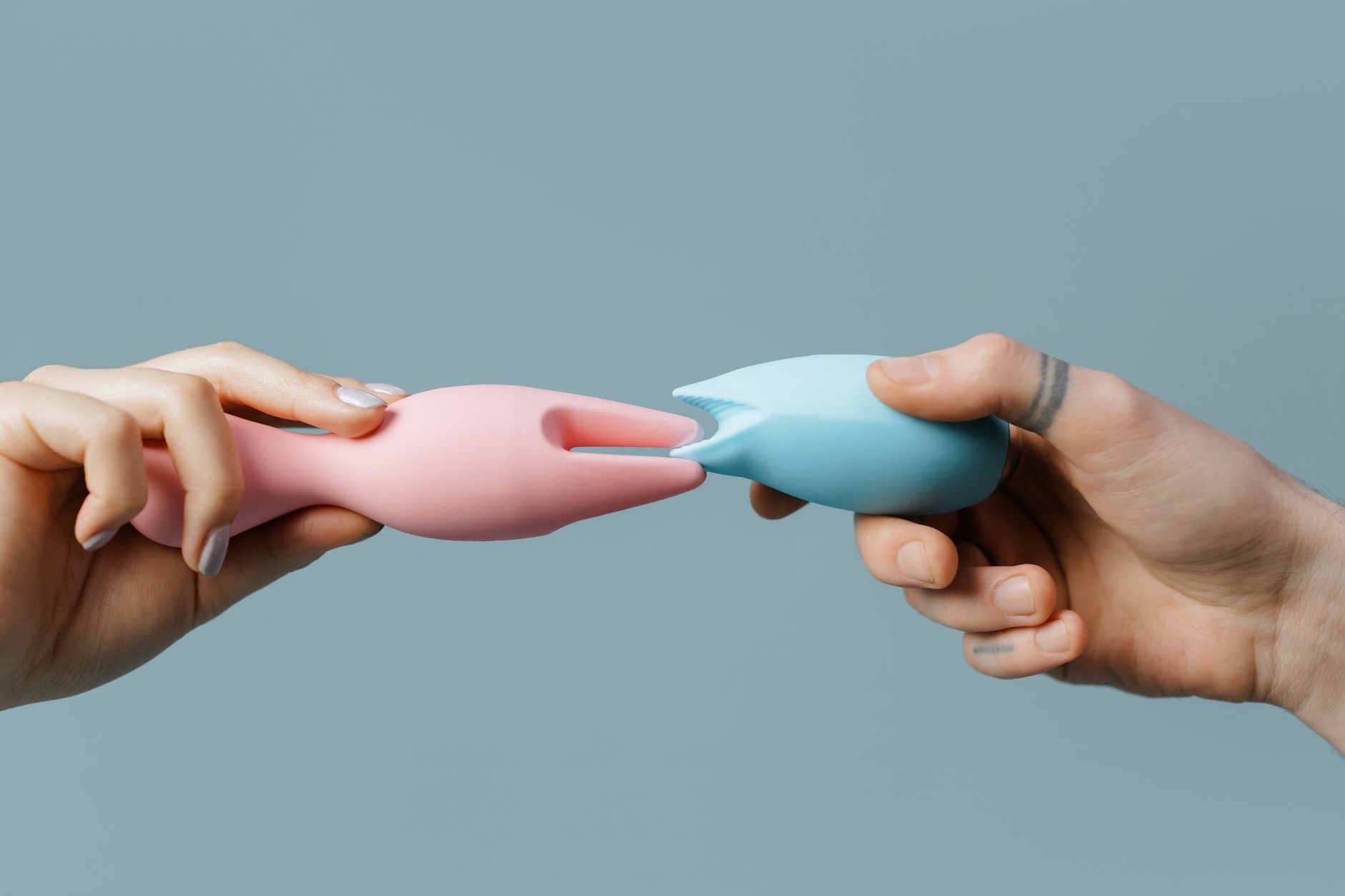
Let's name the real thing first
Your partner says "I don't think we need toys" or "That feels like cheating" or worst, nothing at all but you feel the wall. What they're actually saying is usually one of three things: "I'm worried you don't want me anymore," "I feel like I'm not enough," or "I don't understand what this is for." None of those sentences is about the lemon vibrator itself.
I've worked with hundreds of couples navigating this exact moment. The pattern is always the same. One partner brings home the idea of a toy. The other shuts down. Then both of them assume the conversation is over. It's not. It's just stuck.
The anxiety underneath partner resistance
Here's what happens in your partner's nervous system when you suggest introducing a lemon clitoral vibrator. Their brain connects toys to inadequacy. Not because toys actually mean inadequacy, but because our culture has spent decades telling men (and some women) that a partner who wants external stimulation is a referendum on their performance. It's not rational. It's primal.
Add in the fact that most people have never had an honest conversation about pleasure with a partner, and you're working with a massive knowledge gap. They don't know what a lemon sucker does. They've never heard of suction-based stimulation. They imagine something that threatens their role. So they push back.
What they need is not reassurance. Reassurance sounds like "You're enough for me," which implicitly confirms the belief that toys are a measurement of worth. What they actually need is information and inclusion.
How the conversation actually works
Don't lead with the toy. Lead with what you want.
"I've been thinking about pleasure and how we could both get more out of sex. I read something about clitoral stimulation that made me curious. Would you be interested in exploring that together?"
That's a completely different offer than "I want a vibrator." One is about partnership and shared discovery. The other sounds like a solo project he's not part of.
If he says no, don't push. Instead: "I get that this feels new. What would help you feel more comfortable exploring it?" Then listen. Really listen. He might say he feels replaced. He might say he doesn't know how to use it. He might say he's embarrassed. Each of those gets a different response.
If he says "I feel replaced," the answer is: "That's not what I want. I want us to experience this together. You're part of this, not outside it."
If he says "I don't know how to use it," the answer is: "Neither do I. We figure it out together. It's like learning to dance with someone new."
If he says "I'm embarrassed," the answer is: "I know. I was too. But I realized pleasure is worth the awkwardness."
Reframing toys as a team upgrade
This is crucial and most people miss it. Don't frame the lemon vibrator as something that will replace his touch. Frame it as something that makes his touch better.
A lemon clitoral vibrator doesn't compete with penetration or manual stimulation. It layers on top. It's the difference between eating good food and eating good food with the right wine. The wine doesn't replace the food. It makes the whole experience richer.
When you introduce it this way, you're not saying "You're not enough." You're saying "I want more of us. I want to explore what we're both capable of."
Have the conversation outside the bedroom. Sitting on the couch with coffee, not in bed at 10 p.m. when one of you is already stressed. Show him what you've been reading. Let him ask questions. Give him permission to feel awkward. Say "This is weird for me too. And I think it's worth trying."
The first time with a partner who was hesitant
He's agreed. Now what?
Start without the toy. Have normal sex or foreplay. Let him feel the normal thing first. Then, when arousal is already high and the tension is lower, introduce the lemon vibrator. Not as a replacement for what he's doing, but as an addition.
"I want to try something. Keep doing what you're doing and I'm going to use this." That language is gold because it puts you in control of your own pleasure while keeping him actively involved. He's not watching you use a toy. He's watching you experience more pleasure because of the choice you're making together.
Start on the lowest setting. The sensations are more intense than he probably expects. Watch his face. Some partners feel relief when they see their person experiencing that level of pleasure. Some feel a little jealous at first. Both reactions are normal.
After that first time, debrief. "How did that feel?" Not "Did you like it?" The second question invites judgment. The first invites curiosity. He might say "It was weird but kind of hot." He might say "I felt left out." Either answer is valid and gives you information about what to try next.
Making him part of the experience
One of the smartest moves I've seen couples make is having him operate the lemon clitoral vibrator while they direct. "A little lower," "Go slower," "Right there." Suddenly it's not about inadequacy. It's about collaboration. He has power. He's learning your body. He's part of the story.
Or he holds you while you use it. Or he watches closely and learns exactly what pattern makes you respond. These small shifts transform the dynamic from "You brought this toy because I wasn't enough" to "We're learning each other better."
If resistance lingers, take time. Don't weaponize the toy or punish him for hesitation. Shame is the opposite of what you need. Keep the conversation open. "I know this took time to adjust to. I appreciate you being willing." Recognition matters. It tells him that you see his discomfort and that you valued his willingness to move through it anyway.
When the resistance is actually something else
Sometimes partner resistance to a lemon sucker or any toy isn't about inadequacy. It's about deeper issues. Control. Shame about sexuality. Past trauma. A real mismatch in desire or values. Those conversations need more than a pep talk. They might need a couples therapist.
If after genuine conversation and genuine effort, your partner still refuses to engage with your pleasure in this way, that's important information about the relationship. Not a dealbreaker necessarily, but something worth examining. You deserve a partner who wants your pleasure, even if toys feel uncomfortable at first.
The pleasure that comes after resistance
I've watched couples who initially fought about sex toys become the ones who laugh about their resistance later. "Remember when you thought I wanted this because you weren't enough?" becomes a story of how they learned to talk about hard things.
That's what the lemon vibrator becomes in those relationships. Not a symbol of what was missing, but evidence of what they built together. A tool for communication and connection that happened to have an orgasm attached.
If your partner is resisting, start with curiosity instead of defensiveness. Ask what he's actually afraid of. Listen without fixing. Then invite him into the exploration as a partner, not an outsider. That's how resistance becomes understanding, and understanding becomes the real intimacy.
People also ask
Does using a sex toy mean my partner isn't satisfying me?
No. Using a lemon clitoral vibrator is not a commentary on your partner's capacity to satisfy you. It's an exploration of what your body responds to. Many people need clitoral stimulation that's difficult to provide through penetration or manual touch alone. Adding a toy is an expansion of pleasure, not a replacement. If your partner frames it as rejection, that's a conversation about his insecurity, not about your actual satisfaction with him.
How do I introduce a toy without making my partner feel threatened?
Frame it as something you want to explore together, not something you want him to feel bad about. Say "I've been curious about exploring pleasure differently. I want to experience this with you, not instead of you." Then listen to his actual fears. If he feels replaced, reassure him. If he feels left out, give him a role. Make him part of the discovery, not an audience to it.
What if my partner says no and means it?
Respect that boundary while also checking in with yourself about what it means. Is he saying "Not yet, let's talk more"? Or is he saying "Never, don't ask again"? The first is worth revisiting in a few months. The second is worth asking yourself if you can stay in a relationship where your pleasure is not a team priority. That's not about judgment. It's about compatibility.
Can a lemon vibrator fix a broken relationship?
No. A toy is not a relationship repair tool. If your partnership has deeper problems, a vibrator won't solve them. It might actually make tension worse because it brings everything unsaid into sharp focus. If your relationship is solid and your partner is just hesitant about toys, that's workable. If your relationship is struggling, get support from a therapist first.
How long does it take for partner resistance to disappear?
It depends on the root cause. If it's pure unfamiliarity, a few conversations and one positive experience can shift things within weeks. If it's tied to deeper insecurity or shame about sexuality, it takes longer. Months sometimes. That's okay. You're not trying to rush him. You're trying to invite him. There's a huge difference.
What if we try it once and he still hates it?
One experience isn't enough data. The first time is awkward for almost everyone. Suggest trying it a few more times before deciding if it's not for you both. Sometimes what feels weird on day one becomes hot on day three. But also respect the possibility that he genuinely dislikes it. That doesn't mean he has to ban you from using a lemon vibrator. It means you find a compromise. You use it solo. You use it when he's not home. You explore the boundary without forcing him across it.